Baldwin REALTORS® Release Market Trend Report As Resort Property Prices Rise And Closed Sales Drop
Gulf Shores News Staff • November 7, 2026
Baldwin County Real Estate Report October 2026

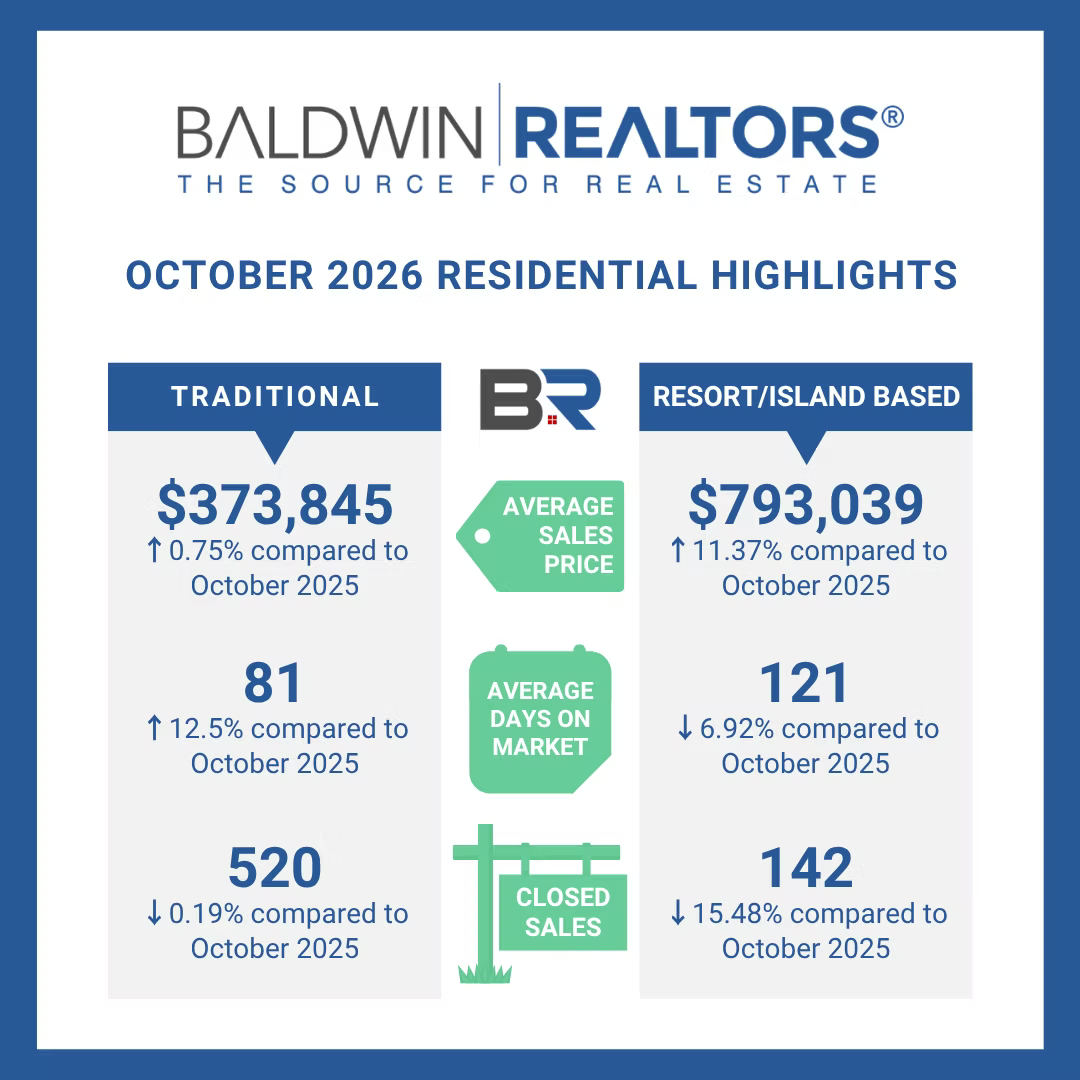
Baldwin County, AL. — (GSN) — Baldwin REALTORS® has published its monthly housing statistics report for October 2026, detailing key shifts in pricing, closed sales, and inventory across the region. As one of Alabama's top-ranked real estate markets by overall sales volume and population growth, Baldwin County real estate sales continue to stand out when ranked against other Alabama counties. The latest figures reveal a dynamic market defined by strong price appreciation in coastal resort sectors despite a noticeable pull-back in transaction volume.
In the Traditional Residential market—covering all other MLS territory across Baldwin County and surrounding service areas—sales activity remained relatively steady. Closed transactions totaled 520 compared to 521 in October 2025, while total dollar volume increased slightly
Residential MLS Stats by Area – October 2026
Central Baldwin
- Residential Properties Sold: 210
- Average Sales Price: $338,335
- Average Days on Market: 88
- Average Sales Price Change from October 2025: Increased 3.98%
Coastal Condos
- Residential Properties Sold: 79
- Average Sales Price: $713,389
- Average Days on Market: 148
- Average Sales Price Change from October 2025: Increased 20.98%
Coastal Homes
- Residential Properties Sold: 96
- Average Sales Price: $926,547
- Average Days on Market: 122
- Average Sales Price Change from October 2025: Increased 11.70%
Eastern Shore
- Residential Properties Sold: 167
- Average Sales Price: $487,322
- Average Days on Market: 75
- Average Sales Price Change from October 2025: Increased 2.55%
North Baldwin
- Residential Properties Sold: 14
- Average Sales Price: $351,187
- Average Days on Market: 109
- Average Sales Price Change from October 2025: Increased 17.69%
Reporting & Methodology Context
Baldwin REALTORS® notes that recent adjustments to MLS area boundaries and the migration to an updated software platform mean data collection now reflects precise geographic lines, which may create minor variations when comparing against historic legacy data.















Recent Posts