
City Council Considers Ordinance Update to Tackle Vacation Rental Oversight
R. Peevy • November 17, 2026
Council work session addresses vacation rentals
Gulf Shores, AL. — (GSN) — During the Gulf Shores City Council work session city leaders evaluated a proposed amendment to the municipal Vacation Rental Ordinance designed to strengthen local oversight of short-term rentals and preserve enforcement tools for property owners and law enforcement.
Airbnb's recent policy changes have created significant friction for professional vacation rental management companies and coastal municipalities. Because the platform restricts hosts and managers from collecting direct guest contact information, requiring signed rental agreements, or performing independent ID verification, local operators warn that they lose essential tools for enforcing property rules, screening for fraud or safety risks, and communicating with guests during emergency evacuations like hurricanes.
The updated ordinance was formally presented by Blake Phelps, Director of Economic Development & Public Affairs.
Phelps explained that the proposed update addresses urgent concerns raised by local vacation rental management companies and individual property owners following policy changes by third-party online booking platforms such as Airbnb. These platforms have restricted property managers from requiring guests to sign separate rental agreements unless explicitly mandated by local municipal law. Without an official local requirement, local operators faced guest anonymity and a reduced ability to enforce house rules, combat fraud, and prevent property damage.
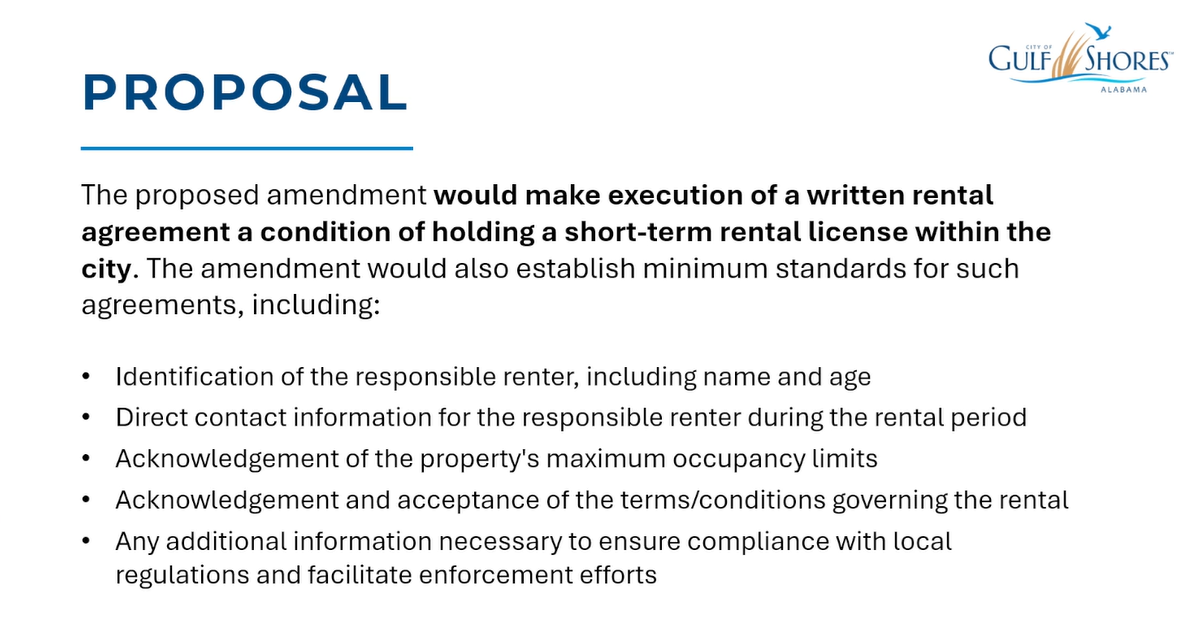
Under the proposed amendment, executing a formal written rental agreement with every short-term guest becomes a mandatory condition for obtaining and holding a short-term rental license in Gulf Shores.
The amendment establishes minimum standards that all written rental agreements must contain:
- Renter Identification: Full name and verified age of the primary responsible renter.
- Direct Contact Information: Valid phone number and contact details for the responsible guest throughout the stay.
- Occupancy Limits: Formal written acknowledgement of the property's maximum allowed occupancy.
- Compliance & Acceptance: Explicit acceptance of property terms, local rules, and noise regulations.
In addition to requiring signed rental agreements for effective enforcement, enforcing maximum occupancy limits enables the city to prevent large, unauthorized gatherings—such as college parties—and helps control the number of vehicles associated with each rental property.
By enacting a mandatory local requirement, Gulf Shores ensures that rental managers and police maintain critical legal authority under Chapter 11 of the City Code to handle disruptive behavior, maintain neighborhood safety, and protect neighboring property owners.
Airbnb is standing firm on its November 20, 2026 rollout date without reversing the policies, though it is facing significant host pushback around the nation and a major shift away from platform exclusivity. While there is no official data yet showing a mass exodus of listings—given that the rules take effect this week—many hosts and professional property managers are threatening boycotts or actively diversifying to competing platforms
During the same session, Phelps also introduced targeted investment rebate programs for the Beach Walking District and Waterway Village District, aimed at promoting walkable development, specialty retail, and boutique lodging.


















Recent Posts