Study Finds Twice As Many Amberjack Than The Federal Authorities Reported
Outdoor Alabama • July 25, 2026
A multi-year study found almost twice the federal estimate
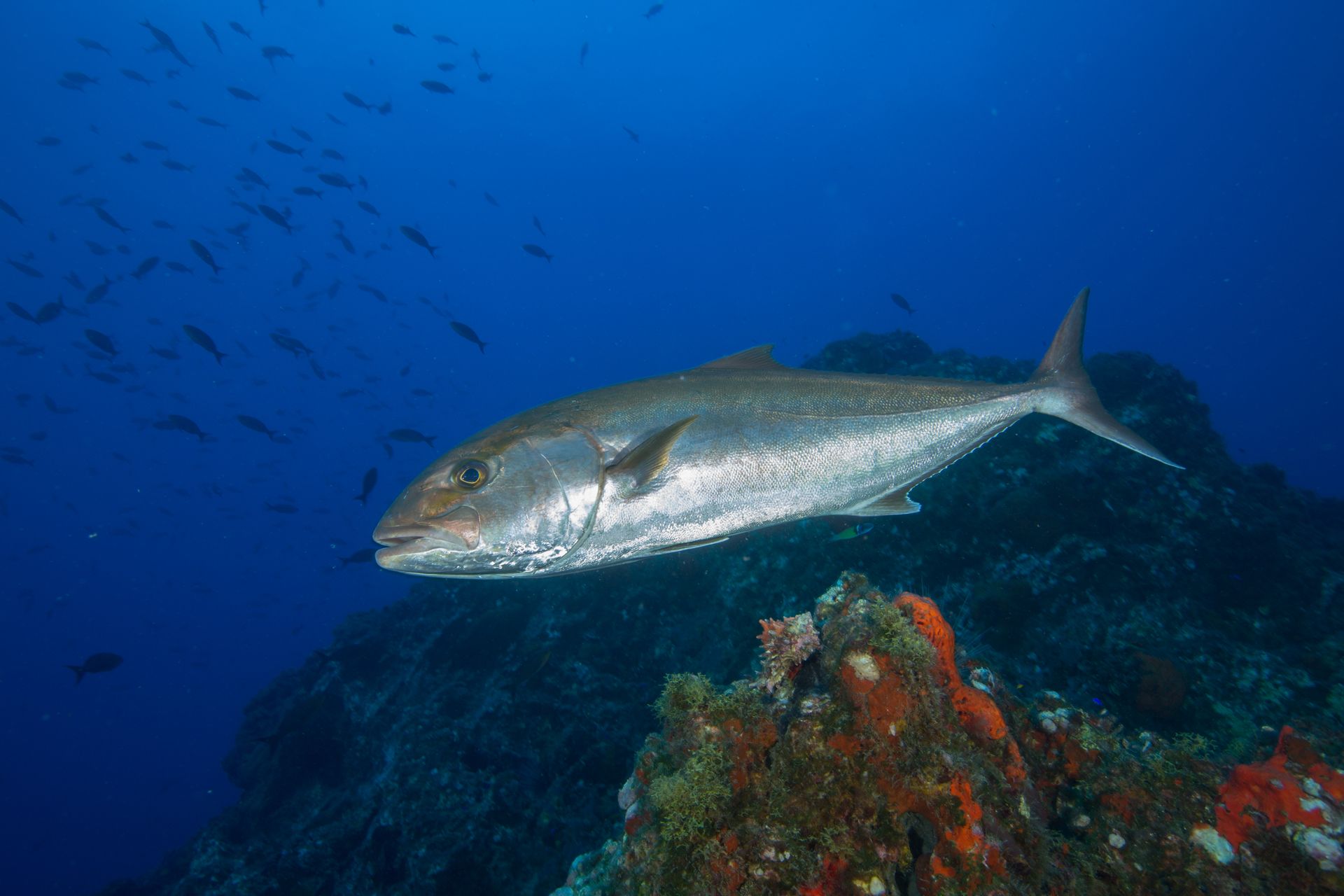
Orange Beach, Ala. — (GSN) — A new multi-year scientific study has found that the Gulf of America holds roughly twice as many greater amberjack as federal fisheries managers have estimated. The research, which used the same methods developed for the landmark Great Red Snapper Count, involved 11 institutions across the Gulf and the South Atlantic. Scientists say the findings raise serious questions about years of increasingly restrictive amberjack seasons. No greater amberjack season has been set for 2026.
Dr. Sean Powers, Director of the Stokes School of Marine and Environmental Sciences at the University of South Alabama, led the study. He shared the findings during a break from his judging duties at the Alabama Deep Sea Fishing Rodeo on Dauphin Island, held each year on the third full weekend in July. The rodeo has not included an amberjack category for more than 15 years.
"For the last four years, we've been working on this project from North Carolina all the way to Texas to obtain an independent estimate of greater amberjack, similar to what we did for the Great Red Snapper Count," Powers said. "The reason we focused on greater amberjack, especially in the Gulf, is that it is a stock that has supposedly been overfished, and overfishing has been occurring for decades."
Powers said the federal numbers never added up. The National Oceanic and Atmospheric Administration (NOAA) Fisheries stock assessment estimates the Gulf's greater amberjack population at 1.5 million fish. The new count found 3.2 million — more than double the federal figure.
"That really never made sense to us that it (overfished condition) could persist for so long," Powers said. "The (NOAA Fisheries) stock assessment has very little other data except for catch data."
Congress appropriated $5 million to NOAA Fisheries and $5 million to the National Sea Grant College Program to fund the study. Researchers conducted fieldwork across reef types and habitats to directly measure population sizes over two years.
"We went out and measured population sizes on different reefs and different habitats where amberjack would occur," Powers said. "We had 11 different institutions involved doing that for two years. The South Atlantic portion (North Carolina to Key West, Florida) of the stock that we found agreed with the stock assessment. We estimated there were 2.2 million greater amberjack 1-plus years old, and their estimate was 2.1."
In the South Atlantic, the population estimates closely matched the federal assessment, and amberjack fishing there is open year-round. The Gulf told a different story. Seasons in the Gulf have grown shorter and shorter, frustrating anglers who say the fish are clearly abundant.
"In the Gulf, we've had shorter and shorter seasons, and the fishermen are asking why are we doing that because they are abundant," Powers said. "Now there are some differences in the stocks in the Western Gulf, where they have really big amberjack, where ours are just above the legal limit (34 inches fork length)."
Kevin Anson, Director of the Alabama Department of Conservation and Natural Resources' Marine Resources Division, said the study's results are promising for fisheries management.
"Over the last ten to twelve years, there have been significant changes in Gulf of America greater amberjack size and bag limits, commercial daily trip limits and season lengths, but the fishery just hasn't responded as anticipated," Anson said. "This research may provide managers with better information on important biological or behavioral factors that could help with identifying more impactful management options."
The research team used underwater video to count fish. In the cloudier waters of the western Gulf, they relied on acoustic cameras that use sound rather than light. U.S. Senator Katie Britt and Former Senator Richard Shelby both supported Congressional funding for the project.
"Senator (Katie) Britt and Senator (Richard) Shelby before her were intrigued that we had to make so many assumptions and that we just needed to be out there counting fish," Powers said. "As long as you have a sample size and you do enough samples in enough different areas, then you can produce the estimate."
ADCNR Commissioner Chris Blankenship credited Congressional support and said the data could benefit coastal communities.
"Congressional support was needed to help us find out more about this species," Commissioner Blankenship said. "The information may lead to more access to amberjack for Alabama anglers and throughout the Gulf, which would be beneficial to coastal communities."
Researchers also made unexpected discoveries about amberjack behavior. Fish in Alabama and Florida waters tend to remain on a reef for 30, 60, or 90 days at a time. Their counterparts in the South Atlantic move on in just three or four days.
"We also found that the fish caught off Alabama and Florida don't get that big, but off Louisiana and Texas, around those oil platforms, they get gigantic," Powers said. "It's not unusual for our colleagues to catch amberjack from 60 to 100 pounds. In our neck of the woods, it's more like 20 to 30 pounds with an occasional big one."
Powers said the team is now working with NOAA Fisheries to reconcile the two population estimates and hopes the Gulf Council will act quickly.
"We went over the amount we were supposed to harvest last year, so the season has been delayed, and no season has been set," he said. "We're hoping the Gulf Council will reconsider it, especially when the fishermen are saying they are abundant. I think that's what they're going to look at under an emergency rule."
"We hope our study will get reconciled with the stock assessment, because we don't even have an amberjack season scheduled yet," Powers added.























Recent Posts